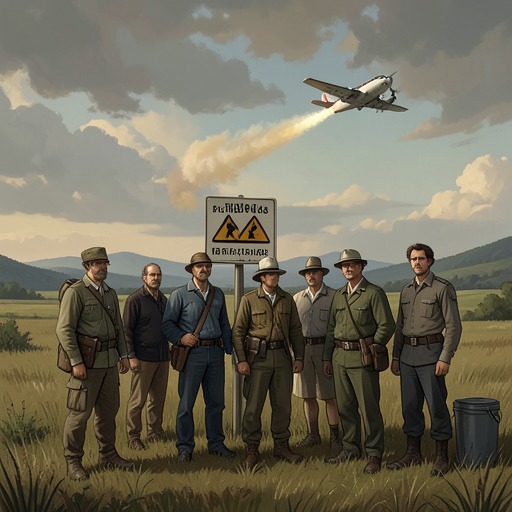
1959 Aerial Aldrin Application in the Detroit Area, Michigan
Silent SpringThe 1959 Aerial Aldrin Application in the Detroit Area, Michigan was a large-scale insect-control campaign whose chemical fallout reached far beyond its stated target. In the fall of 1959, low-flying aircraft dusted 27,000 acres of southeastern Michigan, including suburbs of Detroit, with pellets of aldrin. The episode joined a contested public purpose to a permissive spraying law and a stark aftermath: poison intended for the Japanese beetle descended on residents, birds, and other forms of life alike.
Purpose and Decisions
The campaign was conducted by the Michigan Department of Agriculture with the cooperation of the United States Department of Agriculture. Its announced purpose was control of the Japanese beetle, but Rachel Carson emphasized that little need had been shown for so drastic a response. The choice of aldrin, one of the most dangerous chlorinated hydrocarbons, was not made because the chemical was peculiarly suited to controlling the beetle. It was selected because it was the cheapest of the available compounds. The difference between a chemical’s suitability and its price therefore mattered directly to the risk imposed on people and wildlife.
The decision also sat within a broader wave of chemical beetle-control programs. Michigan, Kentucky, Iowa, Indiana, Illinois, and Missouri were all experiencing chemical fallout in the name of beetle control; the Michigan campaign was among the first large-scale aerial attacks on the Japanese beetle. The book places such programs against the wider postwar spread of persistent poisons in agricultural control. Rachel Carson and scientific colleagues had become alarmed by the widespread use of DDT and other long-lasting chemicals, and Carson undertook the work that became Silent Spring after concluding that the destruction of wildlife and habitat also threatened human life. The Detroit operation is presented not as an isolated technical mishap, but as a local expression of a much larger reliance on chemical intervention.
Aerial Application and Public Exposure
Michigan’s pest-control law allowed the state to spray indiscriminately without notifying individual landowners or obtaining their permission. Acting under that authority, low-flying planes began crossing the Detroit area. The campaign’s reach was therefore determined not by the boundaries of consenting properties, but by the area selected for treatment. Residents had no individual opportunity to accept or refuse the exposure imposed over their land and communities.
Officials’ reassurances did little to make the operation seem benign. One explanation noted that the aircraft were authorized to fly low and added that emergency valves could release an entire load instantaneously. The valves were not used in that way, but the planes continued their work, scattering insecticide pellets over beetles and people alike. The pellets fell on people shopping or traveling to work and on children outside during the lunch hour. A treatment represented as pest control thus became a mass exposure in ordinary public places, where those affected were not the intended targets and had not chosen to be part of the experiment.
The physical form of the treatment helped extend its reach beyond the moment of flight. Accounts described pinhead-sized pellets of aldrin mixed with clay, lodged by the millions; when snow and rain came, every puddle could become a possible death potion. This detail makes the campaign’s hazard more than a passing shower from above: the material remained in the surroundings and could be carried into water after the aircraft had gone. The immediate aerial application and the later possibility of contaminated puddles formed successive stages of exposure.
Reports of Harm
Within days of the dusting, the Detroit Audubon Society began receiving calls about birds. People reported many dead birds and no live ones, including at feeders that had previously drawn birds. Birds found alive but dying displayed symptoms identified as typical of insecticide poisoning: tremors, loss of the ability to fly, paralysis, and convulsions. The reports turned the campaign’s less visible environmental reach into an observable pattern in neighborhoods, where the disappearance of birds and their bodies gave residents reason to question the assurances surrounding the spray.
Birds were not the only animals reported to have been affected. The book records additional impacts on animal life alongside the calls received by the Audubon Society, reinforcing that the chemical’s effects were not confined to the beetle it was intended to kill. This distinction is central to the episode: the intervention was organized around a single pest, while its actual field of exposure included other species sharing the treated environment. The campaign’s broad application and the range of reported casualties illustrate the ecological cost of treating a landscape as though its organisms could be separated into targets and collateral life.
People exposed while watching the planes at work also reported illness. A Detroit internist treated four patients within an hour after their exposure; all showed similar symptoms, including nausea, vomiting, chills, fever, extreme fatigue, and coughing. The local Health Department, despite suggestions that irritation and animal deaths must have come from some other kind of spraying or cause, received a constant stream of complaints. These accounts do not turn every reported symptom into a laboratory finding, but they document a cluster of complaints linked in time to the operation and a serious clinical response to the exposure.
Aftermath and Significance
The Detroit campaign became one of the examples through which Rachel Carson examined the hazards of spraying lethal chemicals over towns and cities as well as forests and fields. Reports of dead birds, symptomatic animals, and illness among exposed residents sharply contrasted with the presentation of the operation as routine beetle control. The disparity exposed a governing problem: the campaign’s intended benefit was narrowly defined, while its risks spread across a community and its surrounding ecology.
The event also made procedure inseparable from toxicity. The state law allowed spraying without notice or permission; aldrin was chosen on grounds of low cost rather than special suitability; and the aircraft released pellets over people going about daily activities. Each choice widened the distance between those who authorized the campaign and those who bore its consequences. The episode’s significance lies not only in the poison’s effects, but in the way an administrative power to treat an area converted residents and wildlife into involuntary recipients of a hazardous intervention.
The account places the operation within a wider history in which chemical controls could be adopted before adequate inquiry into their consequences. In other pesticide programs discussed in the book, research into a chemical’s particular properties followed rather than preceded the launch of control measures. Against that background, the Detroit spraying illustrates the pattern Carson challenged: a campaign justified by the name of a pest, selected in part for economy, and carried out across inhabited land before those exposed could meaningfully consent. The dead birds and the four patients treated within an hour are the concrete counter-record to the official purpose of beetle control.